
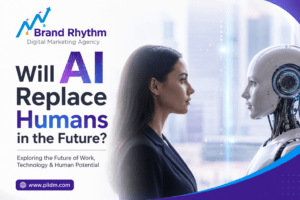
Industries are changing at a rate never seen before because of artificial intelligence (AI). The capacities of computers are expanding quickly, from chatbots providing customer assistance to AI systems forecasting market patterns. This development has raised a frequently asked question:
In certain domains, AI has proven to produce superior results to humans.
The capacity of a machine to carry out cognitive tasks typically associated with human minds, such as perception, learning, reasoning, etc., is known as artificial intelligence. AI is exemplified by Alexa, Siri, ChatGPT, Sophie, the humanoid robot, recommendation algorithms in Netflix or Amazon, Facebook (friends’ recommendations), and Tesla self-driving automobiles.
Understanding AI’s Role
AI is particularly good at repetitive jobs, pattern recognition, and data processing. For instance, AI can produce written material, automate manufacturing processes, and analyse thousands of documents in a matter of minutes. People frequently worry that AI will eventually completely replace human occupations because of its efficiency.
But it’s also crucial to take into account AI’s present limitations. It lacks emotional intelligence, human creativity, and the capacity to make moral decisions, even though it is capable of processing data and carrying out tasks. AI is now unable to perfectly mimic human intuition, empathy, and critical reasoning.
Our daily lives are heavily influenced by artificial intelligence. We ask Alexa or Siri to play our preferred tunes. In our social media pictures, we tag our friends’ faces. When we purchase online, we receive personalised recommendations and learn about products that meet our needs. Autocorrect helps us avoid spelling errors and save time when typing. When interacting with customer assistance, we use chatbots. Climate-controlled air conditioners, self-cleaning vacuums, and other devices. AI has a very broad reach.
Humans are naturally intelligent beings who begin to study and think at a very young age. After analysing issues, we find solutions. We are capable of feeling and expressing our emotions. We think, we ask questions, we are impacted. Since its launch, ChatGPT has been making headlines. We are affected by the environment, we comprehend the situation, and we can alter our choices.
A child cannot be cared for by a robot in the same way that a mother would. AI cannot react in the same manner that humans do when they unintentionally pick up a hot object. We can sympathise and attempt to assist when a dog is struck by a car, but a robot is unable to do so. While AI cannot make decisions for which it is not trained or programmed, we are saddened when an orangutan’s infant is taken from
Its mother was killed due to poaching, and choose to support anti-poaching activities.
Will AI be able to perform every task that humans do?
Jobs That Are at Risk
Automation is more likely to occur in some jobs that need repetitive, rule-based work. Examples include:
Clerks who enter data
- Workers in assembly lines
- Regular customer service positions
Because AI can complete these activities more quickly and accurately, employment patterns may change.
Jobs That AI Cannot Replace
On the other hand, professions that depend on human creativity, emotional intelligence, and sophisticated decision-making are less likely to be completely replaced. Roles such as:
Counsellors and psychologists
- Designers and artists
- Leaders in strategic business
These tasks involve human judgement, interpersonal relationships, and creativity—areas in which AI is yet quite limited.
Are Humans at Risk from Artificial Intelligence?
Concerns about unemployment: AI will replace repetitive or data-driven jobs as well as manual tasks that can be mechanised. Widespread worries about AI taking over human jobs have resulted from this. AI is more likely to displace low-skilled employment; therefore, changing careers might be necessary.
Changes in the workplace: Jobs will become more collaborative with machines. For instance, a data analyst will need to learn how to operate an AI system. Adoption of AI in the workplace will result in an increase in digital education as well as a reassessment of skills and competences. It may have an effect on average pay.
Change in skills: AI will cause a change in workplace skills. The criteria for education will also alter in line with this. Basic cognitive abilities as well as manual and physical capabilities will deteriorate. For instance, data processing, data gathering, and routine manual labour. There will be an increase in higher cognitive, social and emotional, and technological skills. For instance, critical thinking, inventiveness, and sophisticated information processing.
Social impact: As one segment of society gains from AI while another may experience job security concerns and job replacements, economic inequality may increase. Reduced social skills, a loss of personal touch, and a lack of inventiveness can result from a reliance on technology. To offer digital education, the educational system
Misuse and misinformation: When data can be altered, such as in social media manipulation or deepfakes, there is a chance that AI will be misused.
Technological singularity: Scientists and AI specialists caution against the risks of singularity and think it would cause irrevocable changes to human civilisation. Must change.
AI and Humans: Cooperation, Not Rivalry
Collaboration is a more practical viewpoint than considering AI as a successor. AI can enhance human abilities by handling monotonous jobs, allowing people to concentrate on strategic and creative work. For example, AI can swiftly analyse medical imaging in healthcare industry, freeing up physicians to spend more time with patients. While human marketers concentrate on strategy and narrative, AI tools in marketing can automate data analysis.
Getting Ready for a Future Driven by AI
Adaptability is essential to prospering in an AI-driven environment. It will be crucial to embrace technology as a tool rather than a threat, upskill, and pursue ongoing education. In the workplace, soft skills like creativity, sensitivity, and sophisticated problem-solving will become even more important.
Conclusion
AI will definitely alter how we operate, but it is unlikely to completely replace people. Rather, it is likely that people and AI will work together in the future, with humans contributing creativity, empathy, and moral judgement while computers tackle repetitive and data-intensive activities. Whether AI will replace humans is not the true question. It’s whether we’re prepared to change with it.
Hi, this is a comment.
To get started with moderating, editing, and deleting comments, please visit the Comments screen in the dashboard.
Commenter avatars come from Gravatar.